Class 7 Worksheet on Present and Past Participles

Class 7 Worksheet on Present and Past Participles
Describing Actions: Grammar Worksheet on Present and Past Participles for Class 7
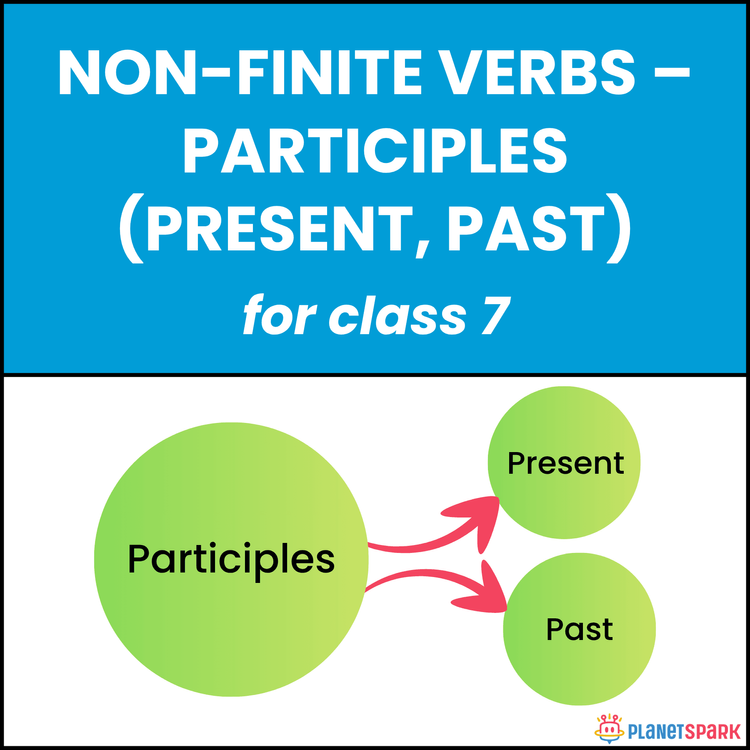
This Grade 7 worksheet focuses on Present and Past Participles — key forms that describe ongoing or completed actions. Through five exercises, students learn how to use participles correctly in sentences to make writing descriptive, concise, and grammatically accurate.
Why Participles Matter in Grammar?
Participles help students:
1. Describe nouns with vivid, action-based details.
2. Join sentences smoothly by replacing clauses.
3. Differentiate between actions happening now and those already done.
4. Improve fluency and clarity in descriptive writing.
What’s Inside This Worksheet?
This worksheet includes five practice-based grammar exercises designed to strengthen understanding of participles:
✏️ Exercise 1 – Multiple Choice Questions
Students choose the correct sentence using the right participle form.
Example: The children were tired after playing all day.
🧠 Exercise 2 – True or False
Students check whether the participle used in each sentence is correct.
Example: The barking dogs woke us up → True
📘 Exercise 3 – Fill in the Blanks
Students fill blanks with the correct present or past participle form of verbs.
Example: The broken cup lay on the table.
📝 Exercise 4 – Sentence Rewriting
Students rewrite sentences using participles to make them shorter and more descriptive.
Example: The man who was driving fast was stopped → The driving man was stopped.
🖊️ Exercise 5 – Paragraph Writing
Students complete a descriptive passage using participles to make the scene vivid and engaging.
✅ Answer Key (For Parents & Educators)
Exercise 1
1. a) Aditi saw the cat jumping on the wall.
2. a) The arriving train stopped near the platform.
3. b) The children were tired after playing all day.
4. a) The cracked window let the cold air in.
5. b) The teacher praised the working students.
6. a) The blooming flowers looked lovely in the sunlight.
7. a) A smiling boy helped the old lady cross the road.
8. b) The students heard the bell ringing loudly.
9. b) The broken glass lay on the kitchen floor.
10. a) Mother saw Aarav doing his homework carefully.
Exercise 2
1. T 2. T 3. F 4. T 5. T 6. F 7. T 8. T 9. F 10. T
Exercise 3
1. shining 2. broken 3. running 4. cooked 5. singing 6. painted 7. crying 8. written 9. dancing 10. built
Exercise 4 (Sample Rewrites)
1. The driving man was stopped.
2. The crying boy calmed down.
3. The painted door looks new.
4. The broken toys lay on the floor.
5. The baking woman smiled.
6. The shouting kids sat quietly.
7. The moving car stopped suddenly.
8. The practising singer smiled.
9. The running student fell down.
10. The helping girl thanked me.
Exercise 5 (Sample Paragraph)
At dawn, Vedika watched the rising sun over Marine Drive, colouring the sky with gold and pink. Crowds moved along the decorated street filled with flags and flowers. Vendors sold roasted peanuts while children waved shining balloons. The mayor greeted the cheering crowd, and music played from painted platforms where dancers performed with smiling faces. Fireworks later lit up the sparkling sea as the closing ceremony began, ending a lively day full of energy and colour.
Help your child describe actions vividly and write fluently with this engaging Class 7 worksheet on participles — perfect for building grammar and style together.
Frequently Asked Questions
Present participles end in “-ing” (running) and show ongoing action; past participles often end in “-ed” (played) or irregular forms.
Participles act as adjectives describing nouns, like “a broken vase” or “a shining star.”
They help students create descriptive phrases and understand complex sentence structures.