Class 4 Reading Passage on The Greedy Merchant

Class 4 Reading Passage on The Greedy Merchant
Greed and Honesty: Reading Comprehension for Class 4
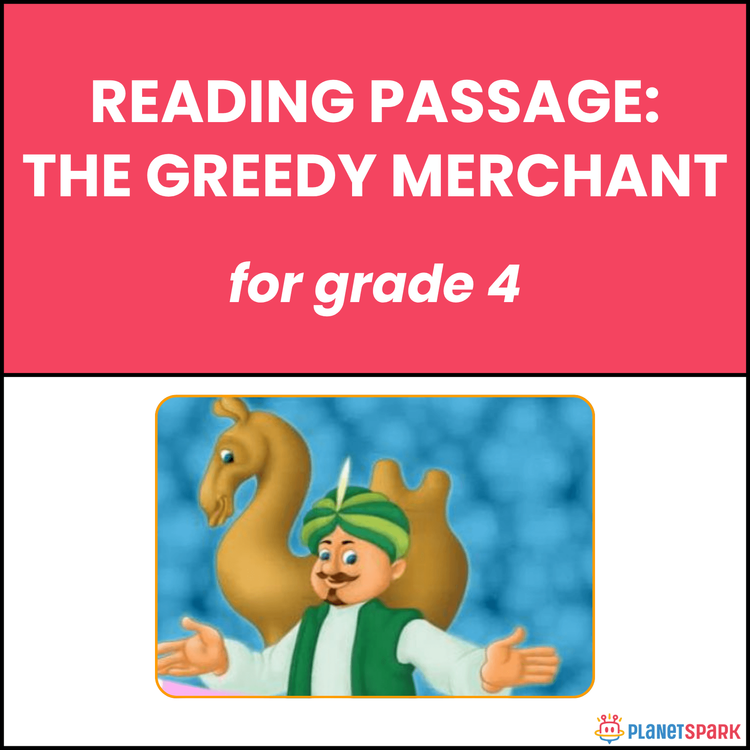
This engaging Class 4 reading comprehension worksheet, titled “The Greedy Merchant,” introduces students to the themes of honesty, fairness, and moral learning through an everyday story. The passage narrates how Raju, a greedy market merchant, cheats his customers using false weights until a disguised District Collector exposes his dishonesty. The exercises following the story help learners practice critical reading, inference, and moral reasoning.
Why Reading Comprehension Matters in Grammar?
1. It builds vocabulary and strengthens sentence understanding in real-life contexts.
2. It helps students identify key ideas, supporting details, and cause-effect relationships.
3. It encourages critical thinking by connecting moral lessons with actions.
4. It improves grammar naturally through reading well-structured sentences.
What’s Inside This Worksheet?
The worksheet includes a short passage followed by three varied exercises that test both factual recall and higher-order thinking skills:
🧠 Exercise 1 – Multiple Choice Questions
Students choose the correct answers to test understanding of key facts such as who visited the market and how Raju was punished.
✏️ Exercise 2 – Text-based Questions
Students answer short questions by quoting or paraphrasing evidence from the passage to strengthen their comprehension and writing clarity.
📚 Exercise 3 – Analytical and Vocabulary Questions
Learners think deeply about character actions, draw moral conclusions, and find meanings of key words or suggest creative new titles.
✅ Answer Key (For Parents & Educators)
Exercise 1 – Choose the Correct Option
1. b) He used false weights to give less than what people paid for
2. c) The District Collector
3. c) He was fined heavily and his license was suspended for six months
Exercise 2 – Answer the Following
1. Customers complained because when they bought one kilogram of apples, they actually received only 800 grams due to Raju’s false weights.
2. The District Collector bought two kilograms of mangoes and found they were 400 grams less when weighed at home.
3. Raju learned that dishonesty brings only shame and loss in the end and began treating customers fairly.
Exercise 3 – Think and Connect
1. Raju’s greed made him use false weights to cheat customers, leading to a fine, loss of shop, and ruined reputation.
2. The Collector dressed simply so Raju would cheat him like any other customer, making it easy to prove his dishonesty.
3. If Raju had been honest, he would have kept his good reputation and earned customers’ trust for a successful business.
4. The word “dishonest” means not honest or truthful. OR New title: “How Greed Brought Shame and Loss.”
Help your child discover the importance of honesty through engaging reading comprehension practice. Enroll today to strengthen literacy and moral learning together!
🔖Book a free trial!
Frequently Asked Questions
They illustrate how selfishness leads to loss, helping children understand the importance of contentment and fairness.
By discussing cause-and-effect relationships between greedy actions and their outcomes in the narrative structure.
They develop moral reasoning, predictive thinking, and understanding that actions directly impact story results and life choices.