
What is Locus in Maths? Learn Core Concepts With PlanetSpark


Table of Contents
- What Is Locus Explained With Simple Examples
- What Is Locus in Maths for Students
- Understanding the Locus of a Point
- Locus of a Point Equidistant from Points
- Locus of a Point Equidistant from Lines
- Locus of a Circle Explained Clearly
- Circle Equation as an Example of Locus
- Locus of Point Formula Explained Simply
- Important Locus Formulas Every Student Should Know
- Locus Equation Explained in Easy Words
- Different Types of Locus in Maths
- A Success Story That Inspires
- Step-by-Step Method to Solve Locus
- Why PlanetSpark Is the Ultimate Destination for Maths Master
- Build Confidence in Maths with PlanetSpark
Mathematics becomes easier when ideas are explained through movement and visual thinking. One such important concept is what is locus, which helps students understand how a point moves to form a shape. This blog explains what is locus in maths in simple words, covering the locus of point, locus of circle, important locus formulas, and locus equations. With clear explanations and guided learning, PlanetSpark helps students build strong mathematical understanding with confidence.
What Is Locus Explained With Simple Examples
To understand what is locus, imagine a point moving on a plane while following a specific condition. The path traced by that moving point is called a locus. In simple words, locus means the set of all positions of a point that satisfy a given condition.
For example, if a point moves such that it is always at the same distance from a fixed point, the path formed will be a circle. That circular path is the locus of the moving point. This idea helps students visualise geometry instead of memorising formulas blindly.
The concept of locus is widely used in coordinate geometry because it connects algebra with geometry. Students learn how equations create shapes and how conditions control movement.

What Is Locus in Maths for Students
When students ask what is locus in maths, the formal answer is that a locus is a geometrical place of points satisfying one or more given conditions. These conditions are usually based on distance, direction, or ratio.
In maths, locus problems help develop logical thinking. They encourage students to analyse conditions carefully before concluding. Locus is not limited to just one shape. Depending on the rule given, the locus can be a straight line, a circle, a parabola, or even more complex curves.
Learning locus builds a strong base for advanced topics like coordinate geometry, conic sections, and graphical representation of equations.
Understanding the Locus of a Point
The locus of point refers to the path traced by a single moving point under specific rules. Every locus problem begins with a point and a condition applied to that point.
Consider these common conditions used to define the locus of point:
The point remains at a fixed distance from another point
The point moves so that the sum of distances from two fixed points is constant
The point moves such that it is always equidistant from two intersecting lines
Each condition produces a different locus. Understanding the locus of point helps students visualise how rules influence movement and shape formation.
Teachers often use graph paper to help learners draw the locus step by step, making the topic more interactive and engaging.
Locus of a Point Equidistant from Points
When a point moves in such a way that its distance from two fixed points remains the same, it follows a specific path. This path is called the locus.
Key points to understand:
There are two fixed points, say A and B
A moving point stays at an equal distance from both A and B
Every position that satisfies this condition lies on the perpendicular bisector of line AB
The perpendicular bisector divides the line AB into two equal parts at a right angle
Support your child with PlanetSpark’s advanced maths tools and teaching methods!
Why does this happen?
Any point on the perpendicular bisector is naturally equidistant from A and B
Points not on this line are closer to one point than the other
Real-life relevance:
Used to find a place equally distant from two locations, like schools or towns
Helps students understand symmetry and balance in geometry
Locus of a Point Equidistant from Lines
When a point moves so that its distance from two intersecting lines stays equal, it follows a specific and predictable path called a locus.
Key points to understand:
Two intersecting lines form an angle
A moving point keeps the same distance from both lines
Every position that satisfies this condition lies on the angle bisectors of the angle
Both the internal and external angle bisectors form the locus
Why does this happen?
Any point on an angle bisector is equally distant from both lines
Points away from the angle bisector are closer to one line than the other
Learning importance:
Helps students understand angles, symmetry, and distance
Improves spatial thinking and geometrical reasoning
Encourages logical understanding rather than memorisation
Give your child the advantage of structured maths learning designed for long-term success with PlanetSpark!
Locus of a Circle Explained Clearly
A circle is one of the best examples used to understand the concept of locus in mathematics.
Key points to understand:
There is one fixed point, called the center of the circle.
A point moves in a plane while keeping a constant distance from the center.
Every position of the moving point forms the boundary of the circle.
The fixed distance is known as the radius of the circle.
Why does this form a circle:
All points at the same distance from the center create a round shape.
Changing the distance changes the size of the circle, not its shape.
Learning importance:
Helps students clearly understand what is locus in maths.
Connects definitions with diagrams.
Prepares students for equations of circles in coordinate geometry.
Circle Equation as an Example of Locus
In coordinate geometry, the idea of locus is expressed using equations. A locus equation represents all points that satisfy the given condition.
For a circle with center at the origin and radius r, the locus equation is:
x² + y² = r²
This equation shows that any point lying on the circle maintains a constant distance r from the center. Learning to convert conditions into equations is a key skill developed through locus problems.
Build a strong foundation in maths concepts with PlanetSpark’s expert-led learning approach!
Locus of Point Formula Explained Simply
A locus of point formula helps students write equations based on distance conditions. These formulas are derived using the distance formula from coordinate geometry.
If a point P(x, y) is at a fixed distance r from a fixed point A(a, b), then the locus of P is given by:
(x − a)² + (y − b)² = r²
This locus of point formula forms the base of many locus problems involving circles and distance-based paths.
Important Locus Formulas Every Student Should Know
Understanding locus formulas is essential for solving numerical and graphical questions. Some commonly used locus formulas include:
Distance between two points formula: Calculates straight line distance between two given points using coordinate differences in plane geometry.
Equation of a circle formula: Represents all points at a fixed distance from a center, forming a perfect circle shape.
Midpoint formula: Finds the exact middle point between two coordinates by averaging their x and y values.
The formula for perpendicular bisector: Determines a line that cuts a segment equally while meeting it at right angles precisely.
These locus formulas help convert verbal conditions into mathematical expressions. Students who practice these formulas regularly find locus problems easier and more logical.
Locus Equation Explained in Easy Words
A locus equation is a mathematical way to describe the path of a moving point using numbers and symbols instead of drawings.
What a locus equation does:
Shows all possible positions of a point in one equation
Represents a shape or path on a graph
Saves time compared to plotting many individual points
Build a strong foundation in maths concepts with PlanetSpark’s expert-led learning approach!
Simple examples to understand:
If a point stays 4 units away from the y-axis, the locus equation is:
x = 4 and x = −4
This forms two straight lines parallel to the y-axis.
If a point stays 3 units away from the x-axis, the locus equation is:
y = 3 and y = −3
This also forms two straight lines.If a point stays at a fixed distance from another point, the locus equation forms a circle.
Why learning locus equations is important:
Improves algebra and graph reading skills.
Helps students understand how equations create shapes.
Makes coordinate geometry easier and more logical.
Different Types of Locus in Maths
In mathematics, the shape of a locus depends on the condition given for the moving point. Different rules create different paths.
Straight Line Locus
Formed when a point moves at a fixed distance from a line.
Example: Points equidistant from the x-axis form two straight lines.
Circular Locus
Formed when a point stays at a constant distance from a fixed point.
Example: All points at a distance r from a center form a circle.
Parabolic Locus
Formed when a point is equidistant from a fixed point and a fixed line.
Example: Distance from a focus equals distance from a directrix.
Elliptical Locus
Formed when the sum of distances from two fixed points is constant.
Example: Used to describe the shape of planetary orbits.
Why learning these types matters:
Helps students understand how conditions affect shapes.
Builds a strong base for coordinate geometry and graphs.
Each type follows a specific rule and set of equations. Studying these variations deepens understanding of geometry and coordinate systems.
A Success Story That Inspires
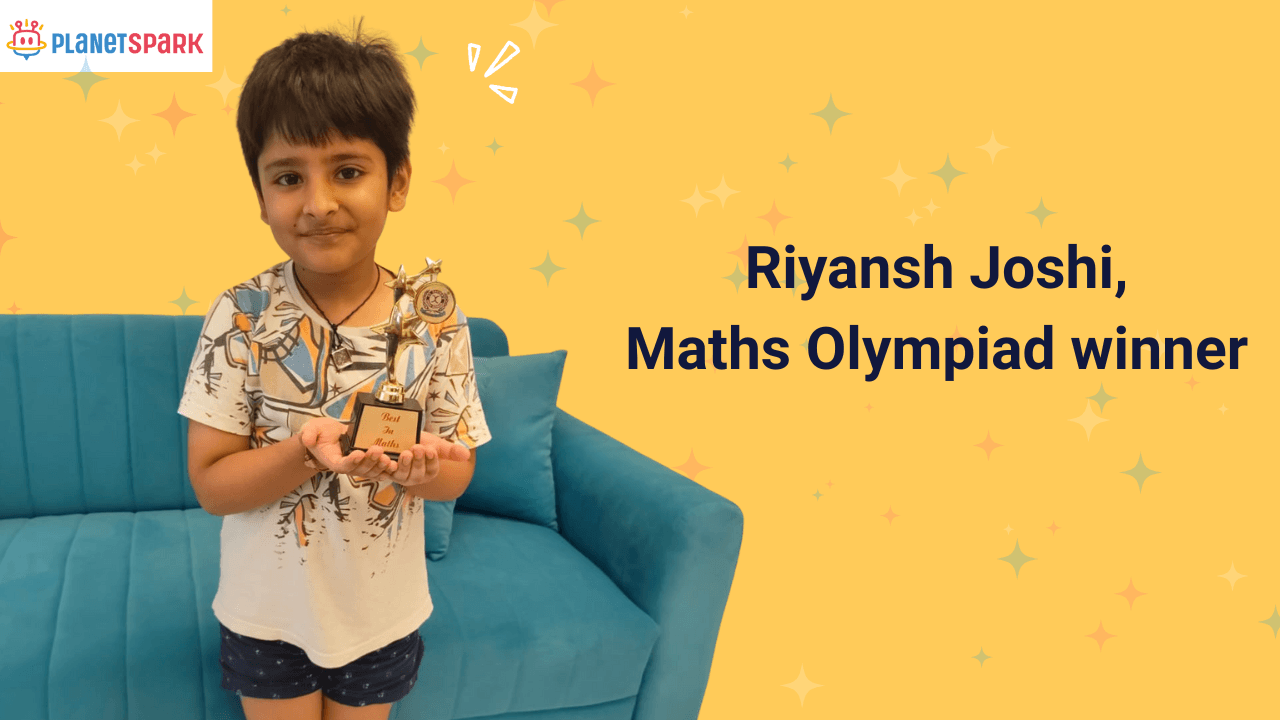
"Riyansh Joshi, a proud Maths Olympiad winner, stands out for his clarity of thought, strong reasoning skills, and confident communication."
Riyansh’s journey shows what focused learning and the right guidance can achieve. If you want to build strong maths skills, think clearly, and grow in confidence, join PlanetSpark and start your own success story today.
Step-by-Step Method to Solve Locus
To solve problems related to what a locus is, students should follow these steps:
Read the condition carefully
Identify fixed points or lines
Use distance or ratio rules
Apply appropriate locus formulas
Write the locus equation
Draw the graph if required
This structured approach makes locus problems less intimidating and more systematic.
Why PlanetSpark Is the Ultimate Destination for Maths Mastery
PlanetSpark delivers a complete learning experience that strengthens every aspect of a child’s mathematical understanding, accuracy, and confidence. With personalised one-on-one guidance, interactive practice, and real-world learning, students don’t just learn math—they master it.
Services That Build Strong Mathematical Skills
Personal Math Trainers for concept correction, problem-solving support, and skill enhancement
Customised Learning Roadmaps tailored to each child’s strengths and learning gaps
SparkX AI Analysis to assess accuracy, speed, and conceptual clarity
AI Guided Practice Sessions for computation, reasoning, and application-based learning
Spark Diary for daily maths practice and real-life number application
Gamified Learning Tools, including Speed Maths, Number Ninja, Logic Lab, and Fraction Quest
SparkBee Daily Quizzes to strengthen calculations, logic, and numerical fluency
SparkShop eBooks covering arithmetic, geometry, data handling, and reasoning
Progress Reports and PTMs offering clear, actionable insights
With PlanetSpark, your child builds mathematical confidence, logical thinking, and a future-ready foundation that lasts a lifetime.
Build Confidence in Maths with PlanetSpark
Understanding locus helps students see geometry as more than just formulas and diagrams. It teaches how movement, distance, and conditions work together to create meaningful shapes. By learning this concept step by step, students develop stronger logical thinking and a clearer approach to problem-solving in mathematics.
With regular practice and guided explanations, learners can easily connect conditions to equations and graphs. This builds confidence in coordinate geometry and prepares students for advanced mathematical topics. A clear foundation makes learning more enjoyable and encourages curiosity and deeper understanding.
Also Read:
Estimation in Maths: Build Speed and Accuracy With PlanetSpark
Profit Loss Formula in Maths: Concept, Examples from PlanetSpark
Frequently Asked Questions
Locus helps students understand how conditions control movement and shape formation. This strengthens logical thinking, improves graph interpretation, and builds a solid foundation for coordinate geometry and higher mathematical concepts.
No, locus connects geometry with algebra through equations and graphs. It helps students see how mathematical rules create visual patterns, making coordinate geometry more meaningful and easier to understand.
Students improve spatial reasoning, problem-solving ability, and analytical thinking. They also learn to convert word-based conditions into equations, which is a key skill in higher-level mathematics.
Locus problems may seem challenging initially, but with step-by-step explanations and practice, they become logical and interesting. A clear understanding of distance and conditions makes solving them much easier.
PlanetSpark uses clear explanations, visual learning, and guided practice to simplify complex maths topics. This approach helps students gain confidence, clarity, and strong problem-solving skills from an early stage.
Parents choose PlanetSpark because it focuses on concept clarity, regular practice, and personalised guidance. Students develop strong maths foundations, improved confidence, and practical skills useful for school and everyday learning.