
Parallel and Perpendicular Lines Explained | PlanetSpark Maths
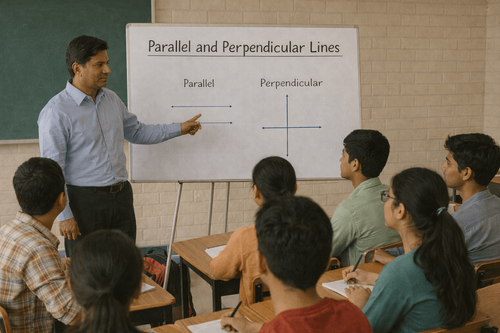

Table of Contents
- Understanding Lines in Geometry: The Foundation of Mathemati
- What Are Parallel Lines?
- What Are Perpendicular Lines?
- Parallel, Perpendicular, and Intersecting Lines Explained To
- Slope: The Key to Understanding Line Relationships
- Equations of Parallel and Perpendicular Lines (Simplified fo
- Visualizing Parallel and Perpendicular Lines in Real Life
- Common Student Mistakes and How to Avoid Them
- How PlanetSpark Strengthens Geometry Learning
- Why Mastering Parallel and Perpendicular Lines Matters
- Build Confidence in Geometry with the Right Guidance
Geometry forms the foundation of logical thinking, spatial reasoning, and real-world problem solving,and at the heart of geometry lie parallel and perpendicular lines. Students frequently search for clear explanations of parallel and perpendicular lines, how they differ from intersecting lines, and how to understand the equations of parallel and perpendicular lines without confusion. This blog is designed to meet exactly that learning need.
If you’re a student trying to master geometry concepts, a parent supporting your child’s math journey, or a learner preparing for school exams or competitive tests, understanding parallel perpendicular and intersecting lines is essential. These concepts appear consistently across middle school and high school mathematics, coordinate geometry, engineering basics, architecture, and even coding logic.
In this guide, you will learn:
What parallel and perpendicular lines are, explained in simple terms
How parallel, perpendicular, and intersecting lines differ
Real-world examples to visualize these concepts easily
How to identify and write the equations of parallel and perpendicular lines
How slope plays a key role in understanding line relationships
Why mastering these concepts builds confidence in higher mathematics
This blog goes beyond definitions. It focuses on concept clarity, visual understanding, exam relevance, and long-term learning,exactly what modern learners need.

Understanding Lines in Geometry: The Foundation of Mathematical Thinking
Before exploring parallel and perpendicular lines, it is essential to clearly understand what a line represents in geometry. A line is a straight path that extends infinitely in both directions and has no thickness, no endpoints, and no boundaries. Unlike a line segment (which has fixed endpoints) or a ray (which extends in one direction), a line continues endlessly, making it one of the most fundamental elements of geometry.
Lines serve as the building blocks of nearly every geometric figure. Shapes such as triangles, rectangles, and polygons are formed by joining line segments, while graphs and coordinate planes rely entirely on straight lines to represent data, functions, and relationships. In real life, lines help model roads, edges of buildings, patterns in design, and layouts in maps,showing how geometry connects directly to the world around us.
When two or more lines exist on the same plane, they do not exist in isolation. Instead, they interact and form specific relationships based on their direction and points of intersection. These relationships allow mathematicians and students to analyze patterns, predict outcomes, and solve complex problems. Broadly, the interaction between lines can be classified into three main categories:
Parallel lines, which run side by side and never intersect, no matter how far they are extended
Perpendicular lines, which intersect at a right angle (90°), forming perfect corners
Intersecting lines, which cross each other at a point but do not necessarily form right angles
Understanding the difference between parallel, perpendicular, and intersecting lines is a critical step in geometry learning. These concepts lay the groundwork for coordinate geometry, slope calculations, angle measurement, and algebraic graphing. Once learners master how lines relate to one another, they can move confidently from basic geometric ideas to more advanced mathematical topics with clarity and precision.
What Are Parallel Lines?
Parallel lines are two or more lines that lie in the same plane and never intersect, regardless of how far they are extended in either direction. Even if the lines continue infinitely, the distance between them remains constant at every point. This unique property makes parallel lines easy to identify and extremely important in geometry.
One of the defining features of parallel lines is that they move in the same direction and have the same inclination, which means they rise or fall at the same rate. Because of this, parallel lines appear to be “side by side” without ever crossing. This concept is widely used in designing roads, buildings, railway systems, and printed materials.
Key Characteristics of Parallel Lines:
They never meet, even when extended infinitely
They maintain a constant distance between them at all points
They have the same slope, meaning they rise or fall at the same rate
They run in the same direction, either horizontally, vertically, or diagonally
Common real-life examples include railway tracks that run alongside each other, evenly spaced notebook lines, ladder rungs, window grills, and road lane markings. These examples help students visualize how parallel lines behave in the real world.
In coordinate geometry, parallel lines play a crucial role. When written in slope-intercept form (y = mx + c), parallel lines always have identical slopes (m) but different y-intercepts (c). This rule makes it easier for students to identify parallel lines just by comparing their equations, and it forms the basis for solving many algebraic and graph-based problems.
What Are Perpendicular Lines?
Perpendicular lines are lines that intersect each other at a right angle (90°). When two lines meet at this angle, they create perfect corners, making perpendicular lines essential in geometry, architecture, engineering, and everyday design.
The most important mathematical feature of perpendicular lines lies in their slopes. In coordinate geometry, the slopes of two perpendicular lines are negative reciprocals of each other. This means if the slope of one line is m, the slope of the line perpendicular to it will be –1/m. This relationship allows students to identify perpendicular lines easily using equations.
Key Characteristics of Perpendicular Lines:
They intersect at exactly 90°
They form right angles, creating square or rectangular shapes
Their slopes are negative reciprocals of each other
They provide structure and balance in geometric figures
Some of the most familiar examples of perpendicular lines include the x-axis and y-axis on a coordinate plane, the corners of a book or table, window frames, tiles on a floor, and chessboards. These examples help learners understand how perpendicular lines create order and symmetry.
Understanding perpendicular lines strengthens a learner’s grasp of angles, slope relationships, coordinate geometry, and graph interpretation. Mastery of this concept is especially important for solving problems involving graphs, equations of lines, and geometric constructions.
Parallel, Perpendicular, and Intersecting Lines Explained Together
To fully grasp geometry, students must understand the differences between parallel perpendicular and intersecting lines.
| Type of Lines | Do They Intersect? | Angle Formed | Slope Relationship |
|---|---|---|---|
| Parallel | No | None | Same slope |
| Perpendicular | Yes | 90° | Negative reciprocal |
| Intersecting | Yes | Any angle except 90° | Different slopes |
Intersecting lines cross at a point but do not necessarily form right angles. Perpendicular lines are a special type of intersecting lines.
This comparison helps students answer exam questions faster and avoid conceptual mistakes.
Slope: The Key to Understanding Line Relationships
Slope measures the steepness of a line and is essential for identifying whether lines are parallel or perpendicular.
The slope formula is:
Slope (m) = (y₂ − y₁) / (x₂ − x₁)
Parallel lines → same slope
Perpendicular lines → slopes multiply to –1
Understanding slope is crucial before learning the equations of parallel and perpendicular lines.
Equations of Parallel and Perpendicular Lines (Simplified for Students)
The equation of a straight line is commonly written as:
y = mx + c
Where:
m = slope
c = y-intercept
Equations of Parallel Lines
Two lines are parallel if:
Their slopes are equal
Their y-intercepts are different
Example:
Line 1: y = 2x + 3
Line 2: y = 2x − 5
These lines are parallel because they have the same slope (2).
Equations of Perpendicular Lines
Two lines are perpendicular if:
The product of their slopes is –1
Example:
Line 1 slope = 2
Line 2 slope = –1/2
If one line is y = 2x + 1, a perpendicular line could be y = –½x + 4.
Understanding these rules helps students solve coordinate geometry problems accurately.
Visualizing Parallel and Perpendicular Lines in Real Life
Geometry is everywhere around us:
Floor tiles show perpendicular intersections
Roads with lane markings demonstrate parallel lines
Buildings rely on perpendicular frameworks
Graphs and charts use both concepts together
Teaching students to connect geometry to real-life visuals improves retention and confidence.
Common Student Mistakes and How to Avoid Them
Students often:
Confuse intersecting lines with perpendicular lines
Forget negative reciprocals for slopes
Mix up equations while solving problems
The solution lies in conceptual learning, not rote memorization,something PlanetSpark emphasizes strongly.

How PlanetSpark Strengthens Geometry Learning
PlanetSpark’s Maths curriculum focuses on:
Concept-first learning
Visual explanations
Step-by-step problem solving
Real-world applications
Exam-oriented practice
Students don’t just memorize formulas,they understand why they work.
Why Mastering Parallel and Perpendicular Lines Matters
These concepts are building blocks for:
Coordinate geometry
Trigonometry
Algebraic graphing
Competitive exams
Logical reasoning
Strong foundations here lead to long-term academic success.
Build Confidence in Geometry with the Right Guidance
Geometry doesn’t have to feel abstract or intimidating. When students clearly understand parallel and perpendicular lines, they unlock a deeper understanding of how mathematics works in the real world. These concepts sharpen reasoning skills, improve problem-solving speed, and prepare learners for advanced topics with confidence.
PlanetSpark’s Maths Course ensures students don’t just learn formulas,they develop conceptual mastery, visual clarity, and exam readiness. With expert-designed lessons, interactive explanations, and structured practice, learners gain the confidence to approach geometry fearlessly.
Enroll in PlanetSpark’s Maths Course today and help your child master geometry the smart way.
Frequently Asked Questions
Parallel lines never meet and stay the same distance apart, while perpendicular lines intersect at a right angle (90°).
Parallel lines don’t intersect, perpendicular lines intersect at 90°, and intersecting lines cross at any angle.
Slope determines whether lines are parallel (same slope) or perpendicular (negative reciprocal slopes).
Parallel lines share the same slope; perpendicular lines have slopes whose product is –1.
PlanetSpark’s Maths Course focuses on concept clarity, real-world examples, and guided practice—helping students master geometry confidently and effectively.