
Circle Properties Basics: Key Concepts and Simple Examples
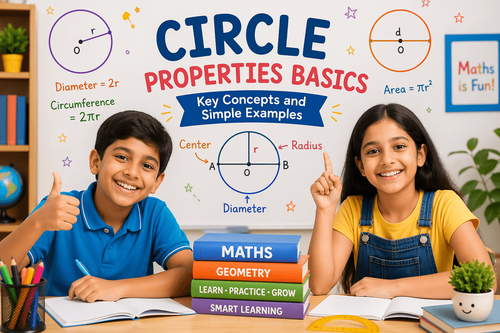

Table of Contents
- What is a Circle and Why Learn Its Properties
- Important Terms in Circle Properties Basics
- Key Properties of a Circle Explained Simply
- Important Formulas in Circle Properties Basics
- Real-Life Examples of Circle Properties
- Common Mistakes Kids Make and How to Avoid Them
- Tips to Master Circle Properties Easily
- Learn Maths the Right Way with PlanetSpark Maths Mastery
- Build Strong Maths Skills with Confidence
Have you ever noticed that a wheel, a clock, and a coin all share the same shape? That shape is a circle, and it plays a big role in both maths and everyday life. Yet, many kids find it confusing to understand how circles actually work. This is where learning circle properties basics becomes important.
In this blog, you will explore the properties of a circle in a simple and engaging way. We will cover key terms, important formulas, real-life examples, and easy tips to make learning fun and clear. By the end, you will feel more confident solving circle-based problems.
Let’s start by understanding what a circle is and why its properties matter.
What is a Circle and Why Learn Its Properties
A circle is a simple geometric shape, but it plays a very important role in mathematics and daily life. It is defined as a set of points that are all at the same distance from a fixed point called the center. This equal distance is known as the radius.
Learning circle properties basics helps kids understand geometry in a structured way. It improves logical thinking, spatial awareness, and problem-solving skills. These are important abilities not just for exams but also for real-life situations.
Circles are all around us. Some common examples include:
- Wheels of bicycles and cars
- Coins and plates
- Clocks and watches
- Balls used in sports
Understanding the properties of a circle helps kids connect maths concepts to the real world. It also prepares them for advanced topics like mensuration, algebra, and trigonometry.

Important Terms in Circle Properties Basics
Before moving on to formulas and problem-solving, it is very important to understand the basic terms used in circles. These terms act as building blocks for all concepts related to circle properties basics. If kids are clear with these definitions, they can easily understand more advanced topics later.
Learning these terms is not just about memorizing definitions. It is about visualizing and understanding how each part of a circle works together. Drawing circles and labeling each part can make learning more fun and effective.
Key Terms Explained
- Center: The fixed point inside the circle from which all distances are measured. It is the most important reference point in a circle.
- Radius: The distance from the center to any point on the circle. All radii in a circle are always equal, which makes the shape perfectly balanced.
- Diameter: A straight line that passes through the center and connects two points on the circle. It is the longest line that can be drawn inside a circle.
- Circumference: The outer boundary or edge of the circle. It represents the total distance around the circle.
- Chord: A line segment that joins any two points on the circle. It does not always pass through the center.
- Arc: A curved portion of the circumference. It can be small or large depending on the section of the circle.
- Sector: A region formed by two radii and the arc between them. It looks like a slice of a pizza.
Understanding these terms clearly makes it much easier to learn and apply the properties of a circle. Kids should regularly practice drawing diagrams and labeling each part to build strong conceptual clarity.
Key Properties of a Circle Explained Simply
Now that we understand the basic terms, let’s explore the most important circle properties basics in a simple and easy-to-understand way. These properties help explain how different parts of a circle behave and interact with each other.
1. All Radii are Equal
Every radius in a circle has the same length because all points on the circle are equally distant from the center. This property ensures that the circle remains perfectly symmetrical.
2. Diameter is Twice the Radius
The diameter is always double the radius, making it the longest straight line in the circle.
Formula: Diameter = 2 × Radius
This relationship is one of the most basic and commonly used concepts in circle problems.
3. Equal Chords are Equidistant from the Center
If two chords in a circle have the same length, they are located at the same distance from the center. This property helps in solving many geometry questions involving symmetry.
4. Perpendicular from Center to Chord Bisects the Chord
If a line drawn from the center meets a chord at a right angle, it divides the chord into two equal parts. This is an important concept used in many geometric constructions.
Want your child to master circle concepts with ease?
Join PlanetSpark Maths Mastery Classes today.
Book a free trial now!
5. The Largest Chord is the Diameter
Among all chords in a circle, the diameter is always the longest because it passes through the center and covers the maximum distance.
6. Angles in the Same Segment are Equal
Angles formed in the same segment of a circle are always equal. This property is very useful when solving problems related to angles and arcs.
7. Angle in a Semicircle is 90 Degrees
Any angle formed in a semicircle is always a right angle. This is one of the most important and frequently used properties in geometry.
These properties of a circle are essential for solving geometry problems accurately and efficiently. With regular practice and clear understanding, kids can apply these rules confidently in exams and real-life situations.
Important Formulas in Circle Properties Basics
Formulas are an important part of learning circle properties basics because they help calculate measurements quickly.
Common Circle Formulas
- Circumference = 2 × π × Radius
- Area = π × Radius²
- Diameter = 2 × Radius
Here, π is a constant value approximately equal to 3.14 or 22/7.
Example Calculations
If the radius is 7 cm:
- Diameter = 14 cm
- Circumference = 44 cm
- Area = 154 cm²
If the diameter is 10 cm:
- Radius = 5 cm
- Area = 78.5 cm²
Understanding these formulas helps students apply the properties of a circle in practical situations. Regular practice with these formulas improves speed and accuracy.
Real-Life Examples of Circle Properties
Learning becomes more interesting when students can relate concepts to real life. The circle properties basics are used in many everyday situations.
Real-Life Applications
- Wheels: The circular shape helps vehicles move smoothly
- Clocks: The circular design helps measure time accurately
- Architecture: Domes and arches often use circular designs
- Sports: Balls used in football, basketball, and cricket follow circular properties
Example Situation
Imagine designing a park with a circular walking path. To calculate the distance around the path, you need to use the circumference formula.
These examples help kids understand how the properties of a circle are useful beyond textbooks.
Struggling with maths concepts like circles?
Help your child learn better with PlanetSpark.
Start a free trial today!
Common Mistakes Kids Make and How to Avoid Them
While learning circle properties basics, many students make small but common mistakes that can affect their understanding and final answers. These errors are usually not because the concepts are too difficult, but because of confusion, lack of practice, or rushing through problems. Identifying these mistakes early helps students improve accuracy, build confidence, and develop a stronger understanding of the properties of a circle.
Common Mistakes
- Confusing radius with diameter
Many students mix up these two terms. They forget that the diameter is always twice the radius, which leads to incorrect calculations. - Forgetting to square the radius in the area formula
When finding the area, students often forget to square the radius. This is one of the most frequent calculation mistakes. - Using incorrect value of π
Some students use the wrong value of π or switch between 3.14 and 22/7 incorrectly, which affects the final answer. - Misunderstanding chords and arcs
Students sometimes confuse straight lines with curved parts of the circle, leading to conceptual errors. - Skipping diagrams while solving problems
Not drawing a diagram makes it harder to visualize the problem, increasing the chances of mistakes.
How to Avoid Them
- Practice regularly with different types of questions
Regular practice helps reinforce concepts and reduces confusion over time. - Draw neat and labeled diagrams
Visual representation makes it easier to understand relationships between different parts of the circle. - Revise formulas daily
Keeping formulas fresh in memory helps avoid calculation errors. - Solve step-by-step instead of rushing
Taking time to solve each step carefully improves accuracy and understanding. - Ask questions when concepts are unclear
Clearing doubts early prevents bigger confusion later. - Double-check your answers
Revisiting your solution helps catch small mistakes before finalizing the answer.
Avoiding these mistakes not only improves problem-solving skills but also builds confidence. With consistent practice and attention to detail, students can master the properties of a circle and solve questions more accurately and efficiently.
Tips to Master Circle Properties Easily
Mastering circle properties basics becomes much easier when students follow the right learning strategies and build a consistent study routine. Instead of memorizing formulas without understanding, kids should focus on clarity, visualization, and regular practice. With the right approach, even complex concepts related to the properties of a circle can become simple and enjoyable to learn.
Want to build strong maths fundamentals early?
Enroll in PlanetSpark Maths Mastery Program.
Get started with a free trial!
Effective Learning Tips
- Start with basic definitions and terms
Always begin with the fundamentals like radius, diameter, chord, and arc. A clear understanding of these basics makes advanced concepts easier to grasp. - Use diagrams and visual aids
Drawing circles and labeling different parts helps in better visualization. Visual learning makes concepts clearer and more memorable. - Practice a variety of problems
Try solving different types of questions, including word problems and diagram-based questions. This builds confidence and improves problem-solving skills. - Relate concepts to real-life examples
Connect circle concepts with objects like wheels, clocks, and coins. This makes learning more interesting and practical. - Revise regularly to strengthen memory
Frequent revision helps retain formulas and concepts for a longer time. It also reduces confusion during exams. - Break down complex problems
Instead of feeling overwhelmed, divide difficult problems into smaller steps. This makes them easier to solve.
Practice Strategy
- Solve at least 5 problems daily
Regular practice builds speed and accuracy over time. - Mix easy and difficult questions
Start with simple questions and gradually move to more challenging ones to strengthen understanding. - Review mistakes and learn from them
Go back to incorrect answers, understand where you went wrong, and avoid repeating the same mistake. - Practice with timed sessions
Solving questions within a time limit helps improve speed and prepares students for exams.
Consistent effort, patience, and smart practice are the keys to mastering the properties of a circle. With the right mindset and regular practice, students can build strong maths skills and solve problems with confidence.
Learn Maths the Right Way with PlanetSpark Maths Mastery
PlanetSpark Maths Mastery classes are designed to make learning maths simple, engaging, and effective for kids. These classes focus on building strong fundamentals in topics like circle properties basics through structured and interactive learning.
Students often struggle with understanding concepts clearly, which leads to confusion and lack of confidence. PlanetSpark solves this problem by offering step-by-step guidance and personalized attention.
Why Choose PlanetSpark Maths Mastery
- Live interactive classes for better understanding
- Expert teachers who simplify complex topics
- Real-world examples to connect learning with daily life
- Personalized feedback to improve performance
- Confidence-building learning approach
- Structured curriculum designed for kids
- Focus on clarity, accuracy, and problem-solving
Boost your child’s maths confidence today
Join PlanetSpark Maths Mastery Classes
Book a free trial now!

Build Strong Maths Skills with Confidence
Learning circle properties basics is an important step in developing strong maths skills and building a solid foundation in geometry. When kids clearly understand the properties of a circle, they not only improve their ability to solve problems but also gain confidence in applying these concepts in real-life situations. This confidence encourages them to explore more advanced topics without fear.
Mathematics is not just about memorizing formulas or getting the right answers. It is about understanding concepts, developing logical thinking, and practicing regularly. When students focus on clarity and consistency, they begin to see patterns and connections that make learning easier and more enjoyable.
With the right guidance, regular revision, and a positive mindset, any student can improve their performance in maths. It is important to stay patient, ask questions when in doubt, and learn from mistakes. Every small step of practice leads to better understanding and stronger skills over time.
Keep practicing, stay curious, and enjoy the journey of learning maths. With dedication and the right approach, mastering circle concepts and other topics becomes not just possible, but truly rewarding.
Also read- Easy Guide to Circle Theorems for Class 9 Learners
Frequently Asked Questions
Circle properties basics include important concepts like radius, diameter, chords, and formulas used to understand circles.
PlanetSpark offers interactive classes, expert teachers, and personalized learning to simplify maths concepts.
Using diagrams, practicing regularly, and learning formulas step by step is the easiest way to understand.
It helps improve logical thinking, builds strong maths foundations, and prepares students for advanced topics.
Yes, these classes are designed for beginners and help build strong fundamentals step by step.