
Vehement Meaning: Definition, Usage & Examples


Table of Contents
- What is Vehement?
- Where to Use ‘Vehement’ in English Grammar?
- Synonyms & Antonyms of Vehement
- Common Mistakes Students Make While Using the Word “Vehement
- How to Teach the Word “Vehement” to Kids (Step-by-Step Guide
- Why Learning the Word “Vehement” Improves a Child’s Creative
- Why Choose PlanetSpark for English Grammar?
- Words That Carry Fire – And the Children Who Learn to Use Th
In English grammar, certain words carry emotional force that adds intensity, clarity, and depth to our sentences. One such powerful word is vehement. Students often come across expressions like vehement argument, vehement protest, or vehement support, but they rarely understand just how expressive and impactful this word can be.
Understanding vehement meaning helps students expand their vocabulary, strengthen their writing skills, and enrich emotional expression in stories, essays, and speeches. For young writers, especially those exploring creative writing, learning how to use strong descriptive words like vehement enhances storytelling and communication.
This blog will help students, parents, and educators understand:
What is vehement?
How to define vehement easily
Where to use vehement in writing and conversations
What vehemently means
Its synonyms and antonyms improve the vocabulary range
By the end, students will not only know the meaning but also feel confident applying the word effectively in their academic work and creative pieces.

What is Vehement?
To define vehement, we must first understand its tone. The word expresses strong, intense, or passionate emotion, usually linked to speech, reactions, or actions.
Definition (Easy for Students):
Vehement (adjective): Showing strong feelings such as passion, force, intensity, or deep emotion.
It is often used when someone expresses an opinion, support, or disagreement with great energy.
Examples:
“She spoke vehemently against bullying.”
“He showed vehement support for his friend.”
“The teacher gave a vehement explanation because the topic was important.”
In Creative Writing:
Using intense descriptive words makes characters feel real. Writers can use vehement to show:
A strong reaction
Passionate dialogue
An emotional outburst
Forceful conviction
This is especially useful in story writing, character sketches, debates, and essays.
Where to Use ‘Vehement’ in English Grammar?
Although vehement is an adjective, it adds emotional value wherever used. It helps describe how strongly someone feels about a topic or situation.
Use it to describe:
Speech: “Her vehement speech moved the audience.”
Opinions: “He made a vehement claim about the project.”
Reactions: “She gave a vehement objection to the idea.”'
Support: “The crowd showed vehement support for the team.”
Actions: “He shook his head vehemently.”
Academic Use:
Essays
Debates
Speeches
Character sketch writing
Book reviews
Creative Writing Use:
Emotional dialogues
Describing strong feelings
Building dramatic scenes
Adding intensity to characters
Students often struggle to express strong feelings in writing. Using words like vehement gives their sentences structure and emotional weight, making stories far more compelling.
Give your child the power to use strong, expressive vocabulary in writing!
Synonyms & Antonyms of Vehement
Building vocabulary is easier when children learn sets of related words. Here are useful synonyms and antonyms of vehement to strengthen English grammar skills.
Synonyms of Vehement (similar words)
Passionate
Intense
Forceful
Emotional
Fierce
Strong
Heated
Energetic
Powerful
Example sentence:
“The speaker gave a passionate and vehement appeal to save the environment.”
Antonyms of Vehement (opposite words)
Calm
Gentle
Mild
Soft
Subtle
Quiet
Unemotional
Example sentence:
“His earlier vehement protests softened into a calm discussion.”
Why Synonyms & Antonyms Matter for Students
Understanding these helps children:
Improve writing depth
Choose the right word for the right emotion
Perform better in comprehension passages
Strengthen vocabulary for creative writing assignments
Learning vehement along with its opposite words helps students understand the full emotional spectrum in language.
Common Mistakes Students Make While Using the Word “Vehement”
The word vehement seems simple, yet many students misuse it, mainly because of its emotional weight. Since the word expresses strong, intense, passionate, or forceful emotion, learners often confuse its usage in formal or conversational English.
Below are the most frequent errors that make writing or speech sound awkward:
Mistake 1: Using “vehement” When Mild Emotion Is Intended
Students sometimes insert vehement language even when describing soft, calm, or neutral behaviour.
Incorrect: She was vehemently happy about the small gift.
Correct: She was sincerely happy about the small gift.
Why? Vehement suggests intensity, anger, passion, urgency, not mild joy.
Mistake 2: Using It Without Understanding the Tone
Vehement is not neutral; it leans emotional.
Example:
Incorrect: He vehemently agreed.
Correct: He strongly agreed.
Better usage: He vehemently denied the accusations.
Mistake 3: Mixing “Vehement” With Incompatible Actions
Some actions cannot logically be “vehement”:
She vehemently whispered.
Whispering is soft; vehement is intense, there’s a contradiction.
Mistake 4: Spelling Confusion Between “Vehement” and “Vehemently.”
Students often write vehemently or vehementally.
Correct forms:
Vehement (adjective)
Vehemently (adverb)
Best place to insert the CTA image:
Right after this section, because students have just understood what they’re doing wrong.
Let your child join now and begin building lifelong writing skills
Limited batches available enroll now for the next creative session
How to Teach the Word “Vehement” to Kids (Step-by-Step Guide for Parents)
Parents often struggle with teaching emotional vocabulary. Words like vehement are not used casually at home, so children rarely pick them up naturally.
Here’s a simple, effective method to teach this powerful word:
Step 1: Start With a Simple Definition
Use relatable language:
“Vehement means showing strong, powerful feelings, like when someone argues or expresses something with force.”
Kids understand better when the explanation mirrors real-life behaviour
Step 2: Use a Mini Story Example
Children respond well to stories.
Example:
Riya vehemently defended her friend during the class debate because she knew he was right.
This shows the emotional force without negativity.
Step 3: Use Real-Life Scenarios
Ask:
“What was the last thing you felt strongly about?”
Then help them frame the sentence using vehement.
Step 4: Add Creative Writing Practice
Children can write:
A situation where a character vehemently disagrees
A dialogue where someone vehemently defends
A scene where emotions are high
This builds emotional vocabulary depth.
Step 5: Encourage Spoken Usage
Practice with short prompts:
“Vehemently deny something.”
“Vehemently support an idea.”
“Vehemently argue your point.”
This strengthens both spoken English and creative writing skills.
If you want your child to learn powerful words like vehement, express emotions creatively, and write like a pro, PlanetSpark is the perfect place to begin!
Why Learning the Word “Vehement” Improves a Child’s Creative Writing Skills
Parents often wonder: Does learning big, dramatic words really help children write better?
Absolutely, vehement is one of those emotionally rich words that can elevate a child’s writing significantly.
Here’s how:
1. Adds Emotional Depth
Instead of writing:
“He disagreed,”
Children can write:
“He vehemently disagreed, slamming the table with frustration.”
This paints a vivid picture and strengthens storytelling.
2. Makes Characters More Lifelike
Characters need emotions.
A vehement reaction shows passion, urgency, or intensity, making the character more dynamic.
3. Enhances Narrative Drama
Moments of tension become stronger:
Arguments feel more real
Dialogues carry weight
Conflicts become sharper
This makes stories more gripping for readers.
4. Improves Descriptive Skills
Students learn how to express:
passion
anger
defense
frustration
urgency
This broadens emotional vocabulary.
5. Helps in Debates, Speeches, and Essays
Children who master expressive words like vehement sound confident and articulate.
It boosts performance in:
elocution
declamation
classroom presentations
written assignments
Why Choose PlanetSpark for English Grammar?
PlanetSpark is built for children who want to think better, express better, and write better. Here’s what makes it the perfect learning space:
Interactive Grammar Learning: Grammar is taught through stories, dialogues, and role plays rather than memorization.
Concept to Application: Each lesson progresses from understanding rules to applying them in sentences and paragraphs.
Gamified Tools: Children enjoy grammar through quizzes, puzzles, and online games that reinforce concepts effectively.
Writing Integration: Students practice grammar skills through real writing and sentence-building exercises.
Skill Progression: The structured program advances from basics like nouns and verbs to complex grammar such as conditionals and reported speech.
Parent Progress Reports: Detailed progress updates highlight improvements in grammatical accuracy and writing fluency.
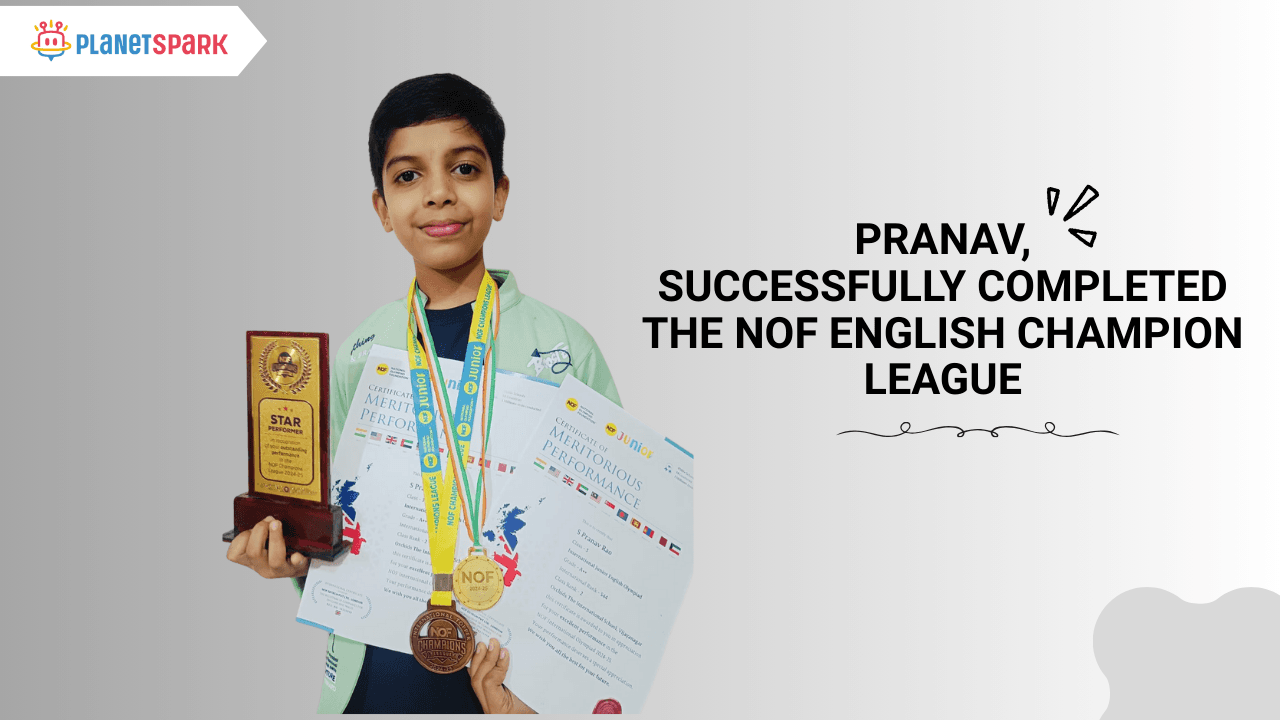
Pranav, a bright and confident Grade 3 student, recently achieved something remarkable: he completed the NOF English Champion League, standing out for his Creative Writing excellence and Public Speaking brilliance.
What makes Pranav’s achievement special?
He writes with emotion, expression, and clarity
He uses strong vocabulary, yes, even words like vehement, to bring characters alive
He speaks with confidence, modulation, and storytelling power
He presents ideas with passion, much beyond his age
Pranav’s journey is proof that with the right guidance, children can achieve incredible growth in both writing and speaking. His success inspires countless young learners to discover their own creative spark.
Your child could be the next shining star!
Give your child the power to write vividly, express confidently, and use impactful vocabulary like vehement with ease.
Words That Carry Fire – And the Children Who Learn to Use Them
The word vehement is powerful, not just in sound, but in meaning. When children learn emotionally rich vocabulary, they don’t just improve their grammar; they learn to express themselves with confidence, colour, and personality.
Whether your child writes stories, debates in class, speaks on stage, or simply wants to communicate better, mastering expressive words helps shape:
Stronger ideas
Clearer sentences
More dynamic writing
Emotionally rich storytelling
Confident speaking skills
Just like Pranav, every child has a voice worth strengthening and a story worth telling. With structured learning, expert mentorship, and a platform that nurtures creativity, kids don’t just learn vocabulary—they learn the power of expression.
Frequently Asked Questions
“Vehement” means showing strong, intense, or passionate emotion, often expressed loudly, forcefully, or with great emphasis.
Example: She vehemently disagreed with the rule.
No. While it is often used for anger or disagreement, it can also be used for passion, support, defense, or enthusiasm.
Example: He vehemently supported his friend’s idea.
Absolutely. It enhances emotional description, adds dramatic flair, and helps children learn advanced vocabulary for storytelling, speeches, and descriptive writing.
Both express strong emotion, but “vehement” specifically highlights the force or emphasis behind the emotion.
Example:
- Intense feelings of fear (internal emotion)
- Vehemently denying accusations (external expression)
Use memory hooks:
- V for Very strong emotion
- Vehement voice = Forceful voice
- Teach through short examples, real-life moments, or storytelling exercises.