
How to Validate Career Choices Before Making Irreversible Moves

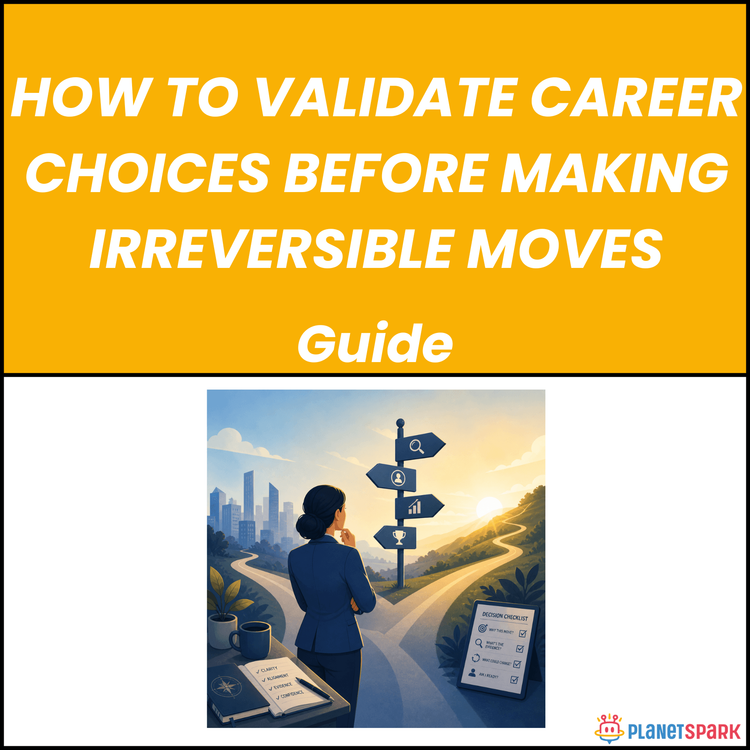
How to Validate Career Choices Before Making Irreversible Moves
A Practical Guide for Working Professionals to Validate Career Choices Before Making Irreversible Moves
Making a career move is rarely just a professional decision—it’s a personal, financial, and emotional commitment. Yet, many professionals make these decisions based on assumptions, trends, or momentary dissatisfaction, only to realize later that the new path isn’t what they expected.
The real challenge isn’t choosing a new direction—it’s validating whether that direction is actually right for you before you commit.
This resource is designed to help you test your career choices in a structured, low-risk way, so you can move forward with clarity and confidence instead of doubt.
Who Is This Resource For?
This resource is particularly useful for:
- Professionals considering a career switch but unsure if it’s the right move
- Individuals exploring multiple career options and feeling overwhelmed
- Job seekers who want to avoid making the wrong choice under pressure
- Early to mid-career professionals seeking more meaningful or aligned work
- People stuck in analysis paralysis, unable to commit to a direction
- Anyone who wants to reduce risk before making a major career decision
If you’ve ever thought, “What if I choose wrong?”—this resource directly addresses that concern.
What Does This Resource Contain?
This guide provides a structured validation system to test career choices before fully committing. Inside, you’ll find:
- A framework to evaluate different career options objectively
- Methods to identify assumptions you may be making about a role or industry
- Exercises to test your interest, skills, and fit in real-world scenarios
- Validation techniques such as mini-projects, shadowing, and conversations
- Tools to compare multiple career paths side by side
- Reflection prompts to assess what’s working and what’s not
- Decision checkpoints to determine whether to proceed, pivot, or stop
Each section is designed to help you move from uncertainty to informed decision-making.
Summary of the Resource
This resource helps you validate career choices before making irreversible moves by testing them in real-world, low-risk ways.
Instead of relying on guesswork, you will gather evidence through structured experiments and reflections—allowing you to make confident, well-informed career decisions.
How Will This Resource Be Useful?
This resource shifts your approach from “hoping it works out” to “knowing it’s the right fit.”
It helps you:
- Avoid costly career mistakes that are hard to reverse
- Reduce uncertainty and overthinking
- Gain real insights into roles, industries, and day-to-day work
- Build confidence through tested experience, not assumptions
- Make faster, clearer decisions with less emotional stress
- Create a repeatable process for future career decisions
Ultimately, it allows you to move forward with conviction rather than hesitation.
How Should You Use This Resource?
To maximize its value, follow a structured approach:
1. Identify Your Options
List the career paths you are seriously considering. Be specific rather than vague.
2. Surface Your Assumptions
Write down what you believe about each option—salary, work type, growth, satisfaction.
3. Design Validation Experiments
Use the guide to create small, low-risk ways to test each option (projects, conversations, exposure).
4. Execute and Observe
Engage in these experiments actively and pay attention to your experience, energy, and performance.
5. Reflect and Compare
Use the provided tools to evaluate what you learned across different options.
6. Make a Decision
Based on evidence—not assumptions—decide whether to pursue, adjust, or eliminate a path.
7. Repeat if Needed
If clarity isn’t achieved, refine your experiments and continue the process.
Action Steps
- Write down 2–3 career options you’re considering
- List your assumptions about each option
- Design one small validation experiment for each path
- Schedule time this week to execute at least one experiment
- Document what you learn immediately after each experience
- Compare your findings across options
- Decide your next step: move forward, refine, or explore further
Career decisions don’t have to feel like irreversible leaps.
With the right validation process, you can turn them into informed, calculated steps—grounded in real experience rather than uncertainty.
Book your free session today!